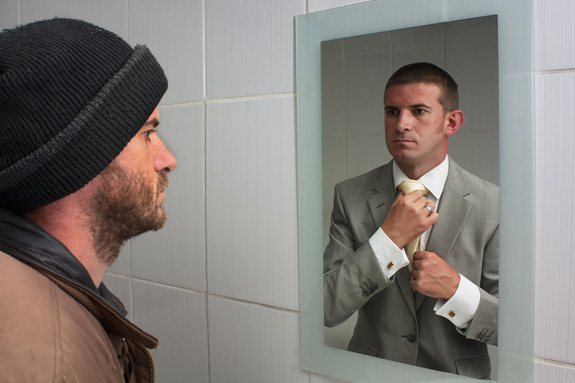
 Often paraphrased as “Be the change you wish to see in the world,” Mohandas Gandhi actually wrote:“We but mirror the world. All the tendencies present in the outer world are to be found in the world of our body. If we could change ourselves, the tendencies in the world would also change. As a man changes his own nature, so does the attitude of the world change towards him. This is the divine mystery supreme. A wonderful thing it is and the source of our happiness. We need not wait to see what others do.” (Vol. 13, Ch. 153, page 241)
Put another way, we might say that leadership is concerned not with being a thermometer, but with being a thermostat. Our primary interest is not just reporting the temperature – but in exerting influence and encouragement in order to change the temperature.
Just as a thermostat must have an accurate thermometer, a leader must be able to honestly assess the current state of the organization in order to make corrections to the environment. However like a thermostat, a leader must also outline the steps necessary to change the climate of the organization toward the preferred future.
As leaders, it’s important that our own attitudes, actions, and words are consistent with this preferred vision of the future. Even though the preferred future is not yet reality, we must live as though it is coming true day by day. As we do this, team members begin to catch the vision, and it not only guides our future – but the present as well. Rarely does this happen all at once, and the wise leader learns to celebrate each baby step toward the goal.
Consequently, change within an organization begins at the top. A leader must not only see the current state of the organization, but have the vision to see the desired future. With that vision in mind, the leader executes the steps necessary to change the culture, and begins to communicate expectations to the team members.
A leader must not only see the current state of the organization, but have the vision to see the desired future. ~ Tweet this!
Instead of merely mirroring the status quo, or getting caught up in the negative aspects of the environment, wise leaders take to heart those words of Gandhi, that by changing oneself – we thereby change the attitudes of the world around us.
What are some of the ways you have seen a leader move from being a thermometer to being a thermostat? What are some of the steps you take toward changing the culture of your organization?
 Leaders are an integral part of our society. In many elementary classrooms there is a boy or a girl line leader to lead the class to the restroom, lunch, and recess. There are even the leaders in the game Simon Says. In this game all who participate must repeat the action of the leader. As children get older leadership transforms into something more complex. Leaders don’t just lead by actions, they lead in their thoughts, ideas, and morals – but what will leadership in the future look like?
 Aaaah… self-development. Most people want to improve and become smarter, healthier, and more successful… but it’s never easy. Often trials and struggles have beat us down and hinder our desire and ability to improve. If crippling personal issues are beating you down, you won’t be able to focus on the road ahead. Here are a few concrete steps to get your mind where it needs to be.
 Once upon a time, there was a great sports hero. He was considered the best in his field. He won several world titles, defeated a bout with cancer, and then won some more world titles. He was famous, people respected him and he earned a lot of money. To give back to the community, he started a charitable foundation and he was admired by all.
 If you visit a bowling alley and watch the bowlers, there are a few things you might see. There will probably be the big guy with a loud voice, throwing the ball as fast as he possibly can. There might be the trendy lady who doesn’t want to bend too much because her pants are too tight. You might see the five year old; who walks up to the line, bends over, and pushes the bowling ball.
 As we passed the half year mark I reviewed my long-term and annual goals and realized that if I wanted to achieve some of my goals, I needed to really help others achieve their goals. I have been using the Ultimate Annual Success Plan this year and it has been enormously helpful in assisting me to achieve my goals. I decided that it was time to give back to my subscribers and help make the second half of this year – your best year ever.

 “Everything is theoretically impossible, until it is done.” An American science-fiction author, Robert A. Heinlein, is responsible for capturing the essence of execution in these eight simple words.
 I usually refrain from posting articles about lessons learned from disasters, just out of respect for the events. This week though, a valuable leadership lesson was displayed to me and the words “put-out or shut-up” is what cycles through my mind.